





News
 Homepage - News
Why More Countries Are Adopting Electric Three-Wheelers?
Seven market drivers behind the global rise of electric three-wheelers—from operating economics and last-mile delivery to local assembly.
SEO Publishing Details (Editor Use Only)
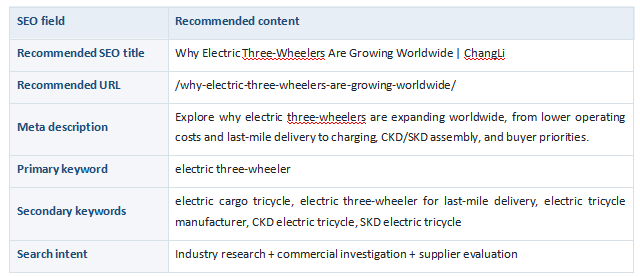
Publishing note: Keep one H1 on the web page. Map the major and supporting headings below to H2 and H3. Use a real application photo with descriptive alt text that mentions the vehicle and use case naturally.
Electric Three-Wheelers Are Moving into the Mainstream
Electric three-wheelers are no longer limited to a handful of regional markets. They are increasingly used for last-mile delivery, rural transport, industrial logistics, municipal services, and passenger mobility. According to the International Energy Agency’s Global EV Outlook 2026, global sales of electric two- and three-wheelers reached about 11 million in 2025. Electric models accounted for more than 25% of worldwide three-wheeler sales. View the IEA data
This growth is not being driven by one policy or one country. Buyers are responding to a practical combination of operating economics, route requirements, charging options, environmental goals, and local industrial policy. The following seven factors explain why the electric three-wheeler is gaining serious attention from governments, distributors, and fleet operators.
Lower and More Predictable Operating Costs
Energy and maintenance expenses have a direct impact on the cost of every delivery or passenger trip. Compared with a similar internal-combustion vehicle, an electric three-wheeler has a relatively simple drivetrain and usually requires fewer routine service items. Where electricity prices and charging access are favorable, energy costs can also be lower than fuel costs. High-utilization fleets can therefore benefit most from the potential savings.The business case should still be tested rather than assumed. A proper total cost of ownership calculation includes the purchase price, financing, electricity, battery replacement, charging equipment, maintenance, insurance, downtime, and residual value.
A Strong Fit for Last-Mile Delivery
Last-mile routes often involve frequent stops, short travel distances, limited road space, and repeated loading and unloading. A compact electric cargo tricycle can move parcels, food, agricultural goods, or supplies without the cost and footprint of a larger van. In many urban, peri-urban, and rural settings, it provides a practical balance of payload, maneuverability, and operating efficiency.The ASEAN Guidelines on Light Electric Vehicles also identify small electric three- and four-wheelers as potential solutions for urban freight and highlight the direct role of logistics companies in fleet electrification.
Charging Options That Suit Light Commercial Fleets
Some electric two- and three-wheelers can charge from standard electrical outlets, while removable batteries enable centralized charging or battery swapping. For fleets that return to a depot overnight, this can reduce dependence on a large public charging network. Battery swapping can be valuable for delivery, taxi, and other high-utilization services where vehicle downtime matters.
Cleaner and Quieter Urban Operations
Electric three-wheelers produce no tailpipe emissions and are generally quieter at low speeds. These characteristics can improve working conditions and local air quality in densely populated areas. As more cities introduce low-emission zones, green procurement policies, and fleet decarbonization targets, light electric commercial vehicles gain additional opportunities.
A responsible environmental claim should refer to zero tailpipe emissions—not “zero emissions” without qualification. Lifecycle performance also depends on the electricity mix, battery manufacturing, service life, and end-of-life management.
Flexible Configurations for Different MarketsElectric three-wheeler platforms can be configured with open cargo beds, enclosed boxes, passenger cabins, sanitation equipment, vending bodies, or other task-specific systems. Battery capacity, motor output, braking, suspension, tires, and body dimensions can also be adapted to payload, terrain, climate, and route requirements. This flexibility allows distributors to build a focused product range instead of offering one configuration everywhere.
SKD and CKD Programs Support Local Assembly
For distant markets, countries with high import duties, or regions encouraging local manufacturing, semi-knocked-down (SKD) and completely knocked-down (CKD) programs can improve container utilization and create opportunities for local assembly. They may also support local jobs and supply-chain development.
However, CKD and SKD decisions should not be based on freight cost alone. Successful programs require clear bills of materials, assembly instructions, tools and fixtures, quality checkpoints, technical training, and consistent parts supply.
Buyers Want Long-Term Manufacturer SupportInternational distributors and fleet operators are buying more than a vehicle. They also need stable supply, spare parts, technical documentation, traceability, and responsive after-sales service. An electric tricycle manufacturer that can provide complete vehicles, SKD/CKD programs, OEM/ODM support, and market-specific configurations can help partners build a more durable local business. Every claim, configuration, certification, and delivery capability should still be confirmed for the specific model and destination market.
Five Checks Before Buying Electric Three-Wheelers
• Regulations and certification: Confirm vehicle classification, type approval, registration, licensing, speed, lighting, braking, and insurance requirements. Rules can differ by country and city.
• Real duty cycle: Provide daily distance, rated payload, road gradient, surface conditions, temperature range, and stop frequency. Do not compare vehicles by advertised range alone.
• Battery and charging: Check battery chemistry, capacity, warranty, charging time, connector, local voltage, and the availability of replacement or swapping options.
• Service and spare parts: Agree on wear parts, the initial spare-parts package, service manuals, diagnostics, training, warranty handling, and response times.
• Shipping and assembly: Choose complete vehicle, SKD, or CKD supply based on landed cost, local capability, and volume. Define assembly standards and acceptance tests before shipment.
How ChangLi Supports Overseas Electric Three-Wheeler Programs
ChangLi focuses on the development and manufacturing of new-energy three-wheelers and can discuss complete vehicle, SKD, CKD, and OEM/ODM programs with overseas partners. Quality management covers the production process from material sourcing and frame welding to vehicle assembly and final inspection. Configurations can be discussed around the intended payload, road conditions, climate, and operating scenario.
To evaluate a project, buyers should share the destination country, use case, target payload, daily distance, road gradients, local voltage, certification requirements, and expected order volume. The more specific the operating data, the more accurately the vehicle and cooperation model can be matched. Product specifications, certifications, lead times, and after-sales terms remain subject to final written confirmation.
Frequently Asked QuestionsAre electric three-wheelers suitable for last-mile delivery?
They often are. Electric three-wheelers are best suited to short routes, frequent stops, moderate payloads, and space-constrained roads. Suitability still depends on payload, range, gradients, weather, and local regulations.
How far can an electric cargo tricycle travel on one charge?
There is no universal range. Battery capacity, payload, speed, gradients, temperature, tire condition, and driving behavior all affect real-world performance. Buyers should request validated duty-cycle data or conduct a route test.
What is the difference between SKD and CKD?
SKD shipments retain more pre-assembled modules and require less local assembly. CKD shipments are broken down further and require a more complete assembly line, technical documentation, and quality system. The exact packing list should be agreed by both parties.
How can buyers evaluate an electric tricycle manufacturer?
Review the production process, inspection system, prototype testing, component traceability, certification documents, spare-parts support, after-sales response, and relevant export experience—not only the price.
Are electric three-wheelers road-legal in every country?
No. Type approval, vehicle classification, registration, insurance, and driver-license requirements vary by market. Importers should confirm the applicable rules with local authorities or qualified specialists before ordering.
Conclusion: Adoption Depends on Practical Value
More countries are adopting electric three-wheelers because the vehicles can solve specific transport problems at an accessible scale. They are compact, potentially economical to operate, adaptable to different applications, and compatible with depot charging or local assembly. The products most likely to earn long-term market acceptance will be those that can demonstrate safety, reliability, regulatory fit, and dependable lifecycle support.